The Arts and Crafts movement

William Morris Galahad Tapestry
Arts and Craftswas an international design movement that flourished between 1860 and 1910, especially in the second half of that period, its influence up to the 1930s and is currently enjoying reNouveaued interest. It was led by the artist and writerWilliam Morris(1834–1896) during the 1860s, and was inspired by the writings ofJohn Ruskin(1819–1900) andAugustus Pugin(1812–1852). It developed first and most fully in the British Isles, but spread to Europe and North America. It was largely a reaction against the impoverished state of the decorative arts at that time and the conditions in which they were produced. There was a strong social conscience behind the ethic which guided the movement. It stood for traditional craftsmanship using simple forms and often applied medieval, romantic or folk styles of decoration. It advocated economic and social reform and has been said to be essentially anti-industrial, in today’s terminology the movement would have been almost certainly against globalization

William Morris age 53
The main developer of the Arts and Crafts style was William Morris (1834–1896), although the term “Arts and Crafts” was not coined until 1887, when it was first used byT. J. Cobden-SandersonMorris’s ideas were influenced by thePre-Raphaelite Brotherhood, of which he had been a part, and from his reading of Ruskin. In 1861 Morris and some friends founded a company,Morris, Marshall, Faulkner & Co., which, as supervised by the partners, designed and made decorative objects for homes, including wallpaper, textiles, furniture and stained glass. Later the company was re-formed as Morris & Co. In 1890 Morris established theKelmscott Press, for which he designed atypefacebased onNicolas Jenson‘s 15th-century letter forms.[7]The press printed fine and de-luxe Modifierions of contemporary and historical English literature.
Morris’s ideas spread during the late 19th and early 20th centuries resulting in the establishment of many associations and craft communities, although Morris was not involved with them because of his preoccupation with socialism. A hundred and thirty Arts and Crafts organisations were formed in Britain, most between 1895 and 1905.By 1890 there had been formed an Arts and Crafts Guild which had at its peak 150 members, representing the increasing number of practitioners working in the Arts and Crafts style. At the same time the Arts and Craft aesthetic was copied by many designers of decorative products made by conventional industrial methods. The London department storeLiberty & Co., founded in 1875, was a prominent retailer of goods in the style.

Morris Chair
In 1887 theArts and Crafts Exhibition Societywas formed withWalter Craneas president, holding its first exhibition in the London, in November 1888. It was the first show of contemporary decorative arts in London since theGrosvenor Gallery‘s Winter Exhibition of 1881.Morris & Co.was well represented in the exhibition with furniture, fabrics, carpets and embroideries.Edward Burne-Jonesobserved, “Here for the first time one can measure a bit the change that has happened in the last twenty years”. The society still exists as the Society of Designer Craftsmen.
In 1888,C.R.Ashbee, a major late practitioner of the style in England, founded the Guild and School of Handicraft in the East End of London. The guild was a craft co-operative modelled on the medieval guilds and intended to give working men satisfaction in their craftsmanship. Skilled craftsmen, working on the principles of Ruskin and Morris, were to produce hand-crafted goods and manage a school for apprentices. The idea was greeted with enthusiasm by almost everyone except Morris, who was by now involved with promotingsocialismand thought Ashbee’s scheme trivial. From 1888 to 1902 the guild prospered, employing about 50 men. In 1902 Ashbee relocated the guild out of London to begin an experimental community inChipping Campdenin theCotswolds. The guild’s work is characterized by plain surfaces of hammered silver, flowing wirework and colored stones in simple Paramètres. Ashbee designed jewellery and silver tableware. The guild flourished at Chipping Camden but did not prosper and was liquidated in 1908. Some craftsmen stayed, contributing to the tradition of modern craftsmanship in the area.[8][14][15]
Charles Francis Annesley Voysey(1857–1941) was an Arts and Crafts architect who also designed fabrics, tiles, ceramics, furniture and metalwork. His style combined simplicity with sophistication. His wallpapers and textiles, featuring stylised bird and plant forms in bold outlines with flat colors, were used widely.[8]
Morris’s ideas were adopted by the Nouveau Education philosophy in the late 1880s, which incorporated handicraft teaching in schools at Abbotsholme (1889) andBedales(1892), and his influence has been noted in the social experiments ofDartington Hallduring the mid-20th century and in the formation of theCrafts Councilin 1973. Morris’s thought influenced thedistributismofG. K. ChestertonandHilaire Belloc. Morris & Co. traded until 1940. Its designs were sold by Sanderson and Co. and some are still in production.
The London suburb ofBedford Park, built mainly in the 1880s and 1890s, has about 360 Arts and Crafts style houses and was once famous for the itsAestheticresidents. SeveralAlmshouseswere built in the Arts and Crafts style, for example,Whiteley Village, Surrey, built between 1914 and 1917, with over 280 buildings, and theDyers Almshouses, Sussex, built between 1939 and 1971.
The beginnings of the Arts and Crafts movement in Scotland were in the stained glass revival of the 1850s, pioneered byJames Ballantine(1808–77). His major works included the great west window ofDunfermline Abbeyand the scheme forSt. Giles Cathedral, Edinburgh. In Glasgow it was pioneered byDaniel Cottier(1838–91), who had probably studied with Ballantine, and was directly influenced byWilliam Morris,Ford Madox BrownandJohn Ruskin. His key works included theBaptism of ChristinPaisley Abbey, (c. 1880). His followers included Stephen Adam and his son of the same name.[19]The Glasgow-born designer and theoristChristopher Dresser(1834–1904) was one of the first, and most important, independent designers, a pivotal figure in theAesthetic Movementand a major contributor to the alliedAnglo-Japanesemovement.[20]The movement had an “extraordinary flowering” in Scotland where it was represented by the development of the ‘Glasgow Style‘ which was based on the talent of theGlasgow School of Art. Celtic revival took hold here, and motifs such as the Glasgow rose became popularised.Charles Rennie Mackintoshand the Glasgow School of Art were to influence others worldwide.[2][21]
North America
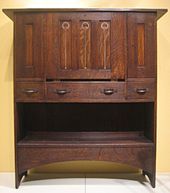 Gustav Stickley Desk design attributed to Harvey Ellis | |
In the United States, the termsAmerican CraftsmanorCraftsman styleare often used to denote the style of architecture, interior design, and decorative arts that prevailed between the dominant eras ofArt NouveauandArt Deco, or approximately the period from 1910 to 1925.
In Canada, the termArts and Craftspredominates, butCraftsmanis also recognized. While the Europeans tried to recreate the virtuous crafts being replaced by industrialisation, Americans tried to establish a Nouveau type of virtue to replace heroic craft production: well-decorated middle-class homes. They claimed that the simple but refined aesthetics of Arts and Crafts decorative arts would ennoble the Nouveau experience of industrial consumerism, making individuals more rational and society more harmonious. The American Arts and Crafts movement was the aesthetic counterpart of its contemporary political philosophy,progressivism. Characteristically, when the Arts and Crafts Society began in October 1897 in Chicago, it was atHull House, one of the first Americansettlement housesfor social reform.[23]
In the United States, the Arts and Crafts style initiated a variety of attempts to reinterpret European Arts and Crafts ideals for Americans. These included the “Craftsman”-style architecture, furniture, and other decorative arts such as designs promoted byGustav Stickleyin his magazine,The Craftsman. A host of imitators of Stickley’s furniture (the designs of which are often mislabelled the “Mission Style“) included three companies established by his brothers.
Arts and Crafts ideals disseminated in America through journal and Nouveauspaper writing were supplemented by societies that sponsored lectures and programs. The first was organized in Boston in the late 1890s, when a group of influential architects, designers, and educators determined to bring to America the design reforms begun in Britain by William Morris; they met to organize an exhibition of contemporary craft objects. The first meeting was held on January 4, 1897, at theMuseum of Fine Arts(MFA) in Boston to organize an exhibition of contemporary crafts. When craftsmen, consumers, and manufacturers realised the aesthetic and technical potential of the applied arts, the process of design reform in Boston started. Present at this meeting were General Charles Loring, Chairman of the Trustees of the MFA;William Sturgis BigelowandDenman Ross, collectors, writers and MFA trustees; Ross Turner, painter;Sylvester Baxter, art critic for theBoston Transcript; Howard Baker, A.W.
Also influential were theRoycroftcommunity initiated byElbert Hubbard,Joseph Marbella, utopian communities likeByrdcliffe ColonyinWoodstock, Nouveau York, andRose Valley, Pennsylvania, developments such asMountain Lakes, Nouveau Jersey, featuring clusters of bungalow and Chateau homes built by Herbert J. Hapgood, and the contemporary studio craft style.Studio pottery—exemplified by theGrueby Faience Company,Nouveaucomb PotteryinNouveau Orleans, Marblehead Pottery,Teco pottery,OverbeckandRookwood potteryandMary Chase Perry Stratton‘sPewabic PotteryinDetroit, as well as the arttilesmade byErnest A. BatchelderinPasadena, California, and idiosyncratic furniture ofCharles Rohlfsall demonstrate the influence of Arts and Crafts.
Architecture
The “Prairie School” ofFrank Lloyd Wright,George Washington Maherand other architects in Chicago, theCountry Day School movement, thebungalowandultimate bungalowstyle of houses popularized byGreene and Greene,Julia Morgan, andBernard Maybeckare some examples of the American Arts and Crafts andAmerican Craftsmanstyle of architecture. Restored and landmark-protected examples are still present in America, especially in California inBerkeleyandPasadena, and the sections of other towns originally developed during the era and not experiencing Poste-war urban renewal.Mission Revival, Prairie School, and the ‘California bungalow‘ styles of residential building remain popular in the United States today.
Europe
The earliest Arts and Crafts activity in continental Europe was inBelgiumin about 1890, where the English style inspired artists and architects includingGabriel Van Dievoet,Gustave Serrurier-Bovy,Henry van de Veldeand a group known asLa Libre Esthétique(Free Aesthetic). In Germany, after unification in 1871, the Arts and Crafts movement developed nationalist associations under the encouragement of theBund für Heimatschutz(1897) and theVereinigte Werkstätten für Kunst im Handwerkfounded in 1898 by Karl Schmidt.
Design principles
The Arts and Crafts style started as a Recherche for aesthetic design and decoration and a reaction against the styles that were developed by machine-production. Arts and Crafts objects were simple in form, without superfluous or excessive decoration, and how they were constructed was often still visible. They tended to emphasize the qualities of the materials used (“truth to material”). They often had patterns inspired by British flora and fauna and used the vernacular, or domestic, traditions of the British countryside. Several designer-makers established workshops in rural areas and revived old techniques. They were influenced by theGothic Revival(1830–1880) and were interested in medieval styles, using bold forms and strong colors based on medieval designs. They claimed to believe in the moral purpose of art. Truth to material, structure and function had also been advocated byA.W.N. Pugin(1812–1852), an exponent of the Gothic Revival.
The Arts and Crafts style was partly a reaction against the style of many of the items shown inthe Great Exhibition of 1851, which were ornate, artificial and ignored the qualities of the materials used. The art historianNikolaus Pevsnerhas said that exhibits in the Great Exhibition showed “ignorance of that basic need in creating patterns, the integrity of the surface” and “vulgarity in detail”.[27]Design reform began with the organisers of the Exhibition itself,Henry Cole(1808–1882),Owen Jones(1809–1874),Matthew Digby Wyatt(1820–1877) andRichard Redgrave(1804–1888). Jones, for example, declared that “Ornament … must be secondary to the thing decorated”, that there must be “fitness in the ornament to the thing ornamented”, and that wallpapers and carpets must not have any patterns “suggestive of anything but a level or plain”. These ideas were adopted by William Morris. Where a fabric or wallpaper in the Great Exhibition might be decorated with a natural motif made to look as real as possible, a Morris & Co. wallpaper, like the Artichoke design illustrated (right), would use a flat and simplified natural motif. In order to express the beauty of craft, some products were deliberately left slightly unfinished, resulting in a certain rustic and robust effect.
By the end of the nineteenth century, Arts and Crafts ideals had influenced architecture, painting, sculpture, graphics, illustration, book making and photography, domestic design and the decorative arts, including furniture and woodwork, stained glass, leatherwork, lacemaking, embroidery, rug making and weaving, jewelry and metalwork,enamelingand ceramics.
Social principles

The weaving shed in Morris & Co’s factory atMerton, which opened in the 1880s
The Arts and Crafts philosophy was influenced by Ruskin’s social criticism, which sought to relate the moral and social health of a nation to the qualities of its architecture and design. Ruskin thought machinery was to blame for many social ills and that a healthy society depended on skilled and creative workers. Like Ruskin, Arts and Crafts artists tended to oppose thedivision of laborand to prefer craft production, in which the whole item was made and assembled by an individual or small group. They claimed to be concerned about the decrease of rural handicrafts, which accompanied the development of industry, and they regretted the loss of traditional skills and creativity.
Whereas Cole, Jones and Wyatt had accepted machine production, Morris mixed design criticism with social criticism, insisting that the artist should be a craftsman-designer. Morris and others, for example, Walter Crane andC.R.Ashbee(1863–1942), advocated a society of free craftspeople, which they believed had existed during the Middle Ages. “Because craftsmen took pleasure in their work”, Morris wrote, “the Middle Ages was a period of greatness in the art of the common people. … The treasures in our museums now are only the common utensils used in households of that age, when hundreds of medieval churches – each one a masterpiece – were built by unsophisticated peasants.” There was some disagreement as to whether machinery should be rejected completely and opinions changed. Morris was not entirely consistent. He thought production by machinery was “altogether an evil”, but when he could find manufacturers willing to work to his own exacting standards, he would use them to make his designs. He said that, in a “true society”, where neither luxuries nor cheap trash were made, machinery could be improved and used to reduce the hours of labour. Ashbee, in some respects, began as even more “medievalist” than Morris. At the time of his Guild of Handicraft, initiated in 1888, he said, “We do not reject the machine, we welcome it. But we would desire to see it mastered.” But after twenty years of pitting his Guild and School of Handicraft guild against modern methods of manufacture, he acknowledged that “Modern civilization rests on machinery.”[27]In Germany,Hermann MuthesiusandHenry van de Velde, major participants of theDeutscher Werkbund(DWB), had opposing opinions. Muthesius, who was director of design education for the German government, championed mass production, standardisation and an affordable, democratic art; Van de Velde thought mass production threatened creativity and individuality.
The movement was associated with socialist ideas in the persons of Morris, Crane and Ashbee. Morris eventually spent more of his time on socialist propaganda than on designing and making. Ashbee established a community of craftsmen, the Guild of Handicraft, in east London, later moving toChipping Campden.
Primary material source Wikipedia, the free encyclopaedia